
Written by:

Julius Baer profit rises 17% as client inflows slowdown
 Reading time: 4 minutes
Written by:

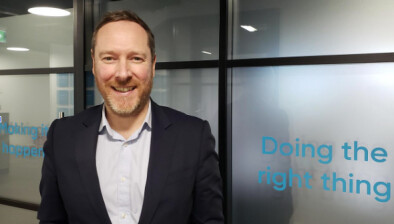
Stefan Bollinger, chief executive of Julius Baer Group (C) Julius Baer
Julius Baer has recorded a 17% increase in profit, despite a slowdown in its annualised client inflow rate from 2.8% in the first ten months of 2025 to 2% over the same period in 2026.
The international Swiss private bank and wealth manager, which has offices in Edinburgh and the rest of the UK, attributed the lower pace to its ongoing de-risking programme, with the group expecting to exit its remaining high-risk clients by the end of 2027 under its revised compliance framework.
In its interim management statement, the group said it was continuing its “efforts to fully align its client book with its revised risk and compliance framework”, adding that the “remaining scope of exit” was now clearly defined and accounted for “less than 2.5% of its assets under management (AuM)”.
The Swiss bank reported that its AuM grew to CHF 553bn, up 6% since the start of the year. The increase was driven by positive stock market performance, the strengthening of the US dollar against the Swiss franc, and continued net new money inflows of around CHF 8.5bn.
Its monthly AuM increased by 9.5% year on year to CHF 538bn, compared with CHF 495bn in the previous period. The group also revealed its net new money target for 2028, which stands at 4-5%.
The group increased its number of relationship managers by 27 since the end of June 2026, taking the total to 1,274. It also reported that the “modest pace of client releveraging seen in the first half of 2026 continued into the next four months”.
The interim statement revealed that all regions recorded strong growth in operating income during the first ten months of 2026 compared with the same period in 2025.
The gross margin for the first ten months of 2026 was 82 basis points, compared with 83 basis points in the previous year.
Activity-driven income was particularly strong during the first quarter, before normalising in the second quarter and slowing further over the most recent four months.
The bank highlighted that 11 basis points of its 22 basis points in net commission and fee income came from non-recurring revenues, while 12 basis points (10M 2025: 12 basis points) came from net income from financial instruments measured at fair value through profit or loss (FVTPL), excluding treasury swap income.
Recurring income within net commission and fee income increased to 38 basis points from 36 basis points in the previous year, supported by an increase in discretionary mandate penetration to 17% at the end of October 2026, up from 16% a year earlier.
Meanwhile, interest-driven income fell by two basis points, from 24 basis points last year to 22 basis points. This comprised five basis points from net interest income, up from two basis points in the previous period, and 17 basis points from treasury swap income, down from 21 basis points.
The implementation of gross efficiency improvements worth CHF 130m, targeted by the end of 2028, remains on track.
On the back of continued cost discipline, the adjusted cost/income ratio improved year on year to 64%, while the adjusted pre-tax profit margin rose to 29 basis points.
Adjusted profit before tax for the first ten months of 2026 rose to approximately CHF 1.3bn, an increase of 17% on the underlying result a year earlier and the strongest on record.
The group said: “The strong performance in the first ten months positions the Group to deliver an IFRS and adjusted net profit for 2026 that is substantially higher than in 2025.”
It added that it was reconfirming its financial targets for 2028, including an adjusted cost/income ratio of less than 67%.
For 2027, the group currently expects its adjusted cost/income ratio to be slightly higher than 67%. It attributed this to the impact of its de-risking programme, the anticipated normalisation of client activity following exceptionally high levels in the first quarter of 2026, and further investment in technology and growth.
Stefan Bollinger, chief executive of Julius Baer Group, said: “During the first ten months of 2026, all-time high assets under management, together with improving operating leverage, drove profitability to a record high, reflecting the strength of our franchise. We also reached several key milestones, including the resolution of long-standing legacy matters and launching a share buy-back programme of up to CHF 600m in November.
“We can now move forward swiftly with our stated objective to have a sustainable client book, aligned with our new wealth management strategy. Looking ahead, our focus remains firmly on supporting our clients in navigating market opportunities and challenges, and delivering long-term shareholder value through the disciplined execution of our strategy.”

Share this article:

Subscribe to our newsletter to not miss articles like this one:
 SUBSCRIBE