
Written by:

Baillie Gifford European Growth Trust reaps rewards of manager change as second-half NAV jumps 27%
 Reading time: 7 minutes
Written by:
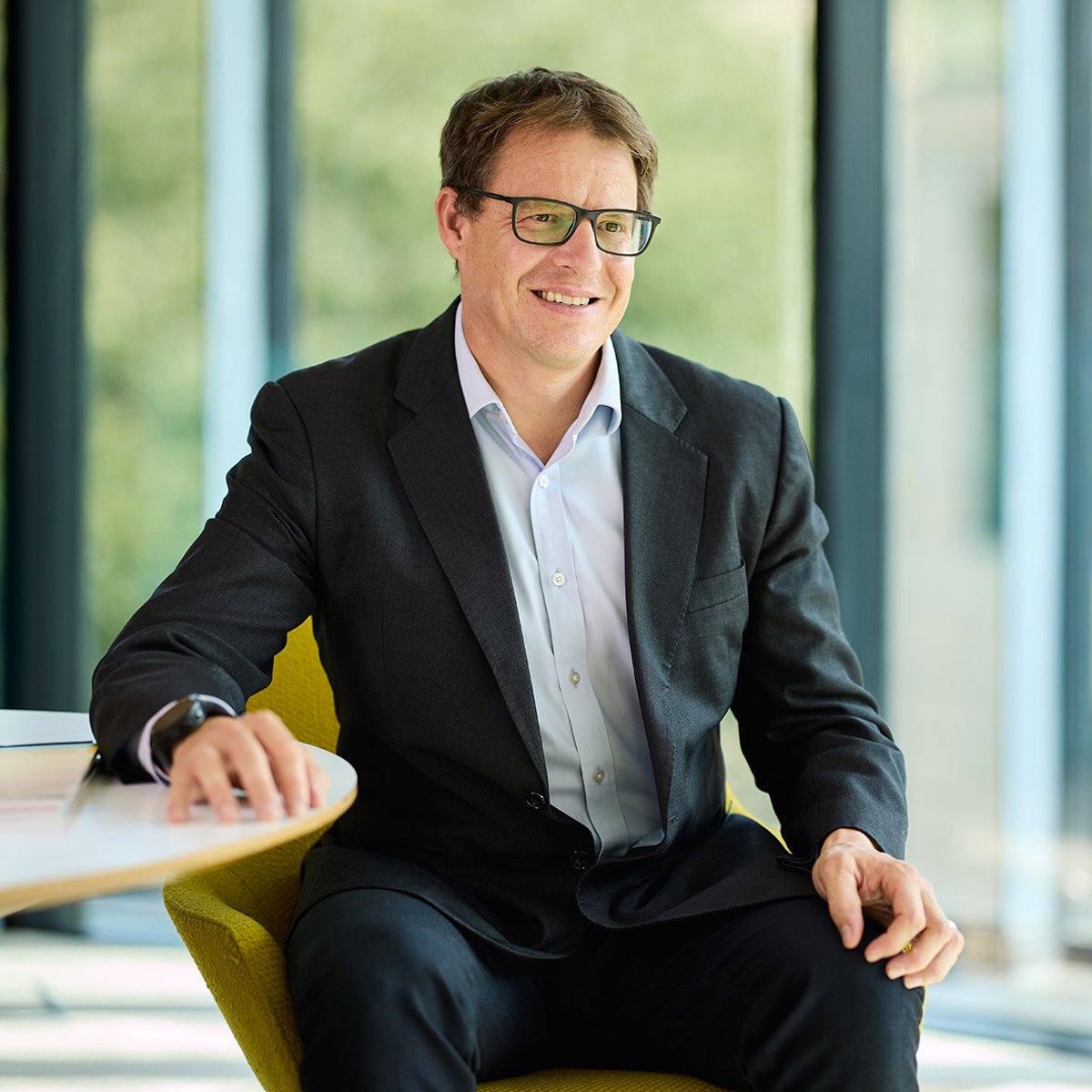
Joe Faraday (C) Baillie Gifford
Baillie Gifford European Growth Trust is reaping the rewards of its decision to appoint Joe Faraday as lead manager, returning to modest outperformance after a year of two very different halves, with his overhaul of the portfolio driving a sharp recovery.
In the year to 30 September 2026, the trust’s net asset value (NAV) total return was 15.2%, against 14.5% for the FTSE Europe ex UK Index. The share price total return was 16.7%. The board called it a “welcome return to outperformance” but said the full-year figures conceal the difference between the two halves.
NAV fell 9.2% in the six months to 31 March, while the benchmark rose 4.4%. Since Faraday took over as lead manager on 1 April, NAV total return was 26.9%, against 9.6% for the benchmark, and the share price total return was 27.9%.
Faraday replaced Stephen Paice and Chris Davies, and changed about a third of the portfolio within the first few months. The board said it spent “considerable time” early in the year discussing performance, portfolio construction and the investment process with the manager.
It said the initial changes led to “considerably greater, one-off portfolio activity”, with turnover of 54.9% for the year. The portfolio held 58 holdings at the year end.
The trust still trails the benchmark over the four-year performance period, which ends on 30 September 2028. At 30 September 2026, NAV was up 21.5% from the start of the period, against 32.2% for the index. By 20 November, it was up 22.7%, against 27.6%.
The trust has promised shareholders a 100% tender offer if it fails to beat the FTSE Europe ex UK Index over that period. The board said the performance-triggered tender offer, announced in 2024, remains an “important element of the company’s commitment to shareholders”.
The discount at the year end was 7.5%, against 8.6% a year earlier. During the year the trust bought back 40.9m shares for about £44m, which is 12.6% of the opening share capital.
The board proposed a final dividend of 1.40p, against 0.72p in 2025. It said this was the minimum required to maintain investment trust status.
A broader view of growth
Speaking at a media roundtable in early November, Faraday said he was keen to “put my imprint on it” when he took over. “If all you’re going to do is focus on Scandinavia and semiconductors, then you are missing what Europe really stands for,” he said.
“You need a broader perspective on what growth you should go after, a willingness to open your mind to a wider set of company types and, importantly, blend that with portfolio construction, rather than holding it too sacred that Europe is only home to a very specific and narrow set of industries or company types.”
He added UBS and CaixaBank to the portfolio. “I am a believer that you can get growth from banks – after all, they are intertwined with European economies so, if they aren’t growing, then the economies probably aren’t growing,” he said.
“My perspective comes from a lot of years looking at emerging markets and macro measures like credit-to-GDP, or the structural growth in economies and what could be a driver of that.”
He said European banks need more consolidation “to be able to compete with the North American banks”, and that there is “a lot of inefficiency baked into Europe. I think Europe almost has one arm behind its back because of that complexity. In spite of that, I still think there are excellent companies, including the banks.”
He also added defence group Rheinmetall and Tekever, a security and aerospace technology company, which is now the third largest holding at 5.1%. “While this [play on defence] hasn’t quite worked out over the past six or so months, it remains important to be plugged in and making sure you are exposed to what could be the growth drivers,” he said.
Much of the portfolio remains anchored in long-standing European heavyweights with an established global presence, such as ASML and Roche, alongside Airbus.
Bending Spoons, the Italian technology company, remains the largest holding at 16.5% of total assets at the year end. The trust held a 4% private position when Faraday took over. It is now part of the listed portfolio following its IPO on Nasdaq in July, and the manager decided to retain all its shares in the IPO. The holding contributed about 10.3 percentage points to the trust’s return for the year to 30 September.
Faraday called it a “slam dunk” for the portfolio. “It has been an absolutely fantastic investment. The lock-up expires in a few weeks and it will be right-sized accordingly,” he said in November. He added: “Long-termism must not be an excuse – you have to get a wriggle on.”
“I reckon every portfolio manager has a weakness when it comes to selling and letting go, [so it’s important to understand] what makes you let go and where your blind spots are. Fall in love with a company, but don’t fall in love with a stock.”
Europe “more like emerging markets”
Faraday said the early evidence showed that “repositioning is encouraging”.
“To me, Europe looks more like [the] emerging markets – it’s diverse, an eclectic mix. But you can really lose your shirt if you’re too narrow, or too myopic, or you’re just a thematic investor. It’s worth tuning into the full opportunity set.”
He stressed the importance of looking beyond the larger countries that typically dominate indices, such as France and Germany, which together make up more than 30% of the FTSE Europe ex UK Index.
“There are big structural challenges ahead for France [as it deals with political and civil unrest], while Germany is trying to put through this huge stimulus in defence and infrastructure spending but, if it weren’t for that, Germany would also be very fragile,” he said.
He argued there is a “shifting dynamism” in Europe and “grounds for optimism” in several countries. “I’m seeing a big return of southern Europe after 15 to 20 years of pain. Spain is enjoying growth and productivity and Greece is focused on attracting high net-worth individuals and financiers,” he said.
Faraday predicted that the rise of eastern European countries would be a trend “for the next decade or two”, noting that Poland is enjoying a “formidable rise”. He acknowledged that the trust was previously “very skewed” away from southern and eastern Europe, in favour of Scandinavia and the Benelux.
Board optimism
The board said the objective remains to identify companies capable of creating significant value over the long term, but with a more robust framework for portfolio construction, valuation, cash generation and balance sheet resilience, so that returns do not depend on a narrow set of economic or market conditions.
“The manager is increasingly looking for durable value creation across businesses ranging from technology and industrial companies to financial franchises, regulated assets, energy companies and holding companies,” it said.
Private companies have always been part of the mandate and “represent an important element of the opportunity set, enabling access to a broader range of growth companies”, the board said, adding that it continues to believe this flexibility can be valuable. At the year end the trust held seven unquoted investments, representing 8.7% of total assets.
“Whilst the improvement in performance is clearly welcome, the board is further encouraged by the fresh approach and the clarity of thinking and execution that the new manager has brought to the management of the portfolio. With its distinctive approach, the board views the future of the company with increased optimism,” it said.

Share this article:

Subscribe to our newsletter to not miss articles like this one:
 SUBSCRIBE