

ICAS: AI can’t replace human judgement in accounting
 Reading time: 4 minutes
(Credit: Thapana Studio - stock.adobe.com)
More than two-thirds (72%) of accounting professionals fear that generative artificial intelligence (Gen AI) could produce errors or reach incorrect decisions, according to a year-long research study commissioned by the Institute of Chartered Accountants of Scotland (ICAS).
The findings come from a major new report ‘Generative AI and Professional Judgement in Accounting’, published today as part of ICAS’ Shaping the Profession programme. The research project outlines one of the most comprehensive examinations to date of how Gen AI is influencing accountancy and professional judgement, highlighting the critical importance of maintaining human oversight as the technology takes on a more routine role in daily work.
Conducted by research partners from Alliance Manchester Business School and Aston Business School, the study provides rare real-world insight into how Gen AI is being adopted at the mid-tier UK accounting firm Beever and Struthers (now part of Menzies LLP).
Drawing on firm-wide surveys of more than 200 accounting professionals, 50 in-depth interviews, targeted skills development activities, and four detailed case studies, the project explores accountants’ use of the technology in day-to-day practice and how it is shaping their professional judgement.
Key findings include:
- Gen AI is boosting productivity: Nearly three-quarters of the accounting professionals surveyed (74%) say the technology speeds up the tasks they perform, with many highlighting quicker data extraction, document analysis and information cross-referencing. Yet fewer than a quarter (22%) say this has translated into a substantial increase in their overall work rate.
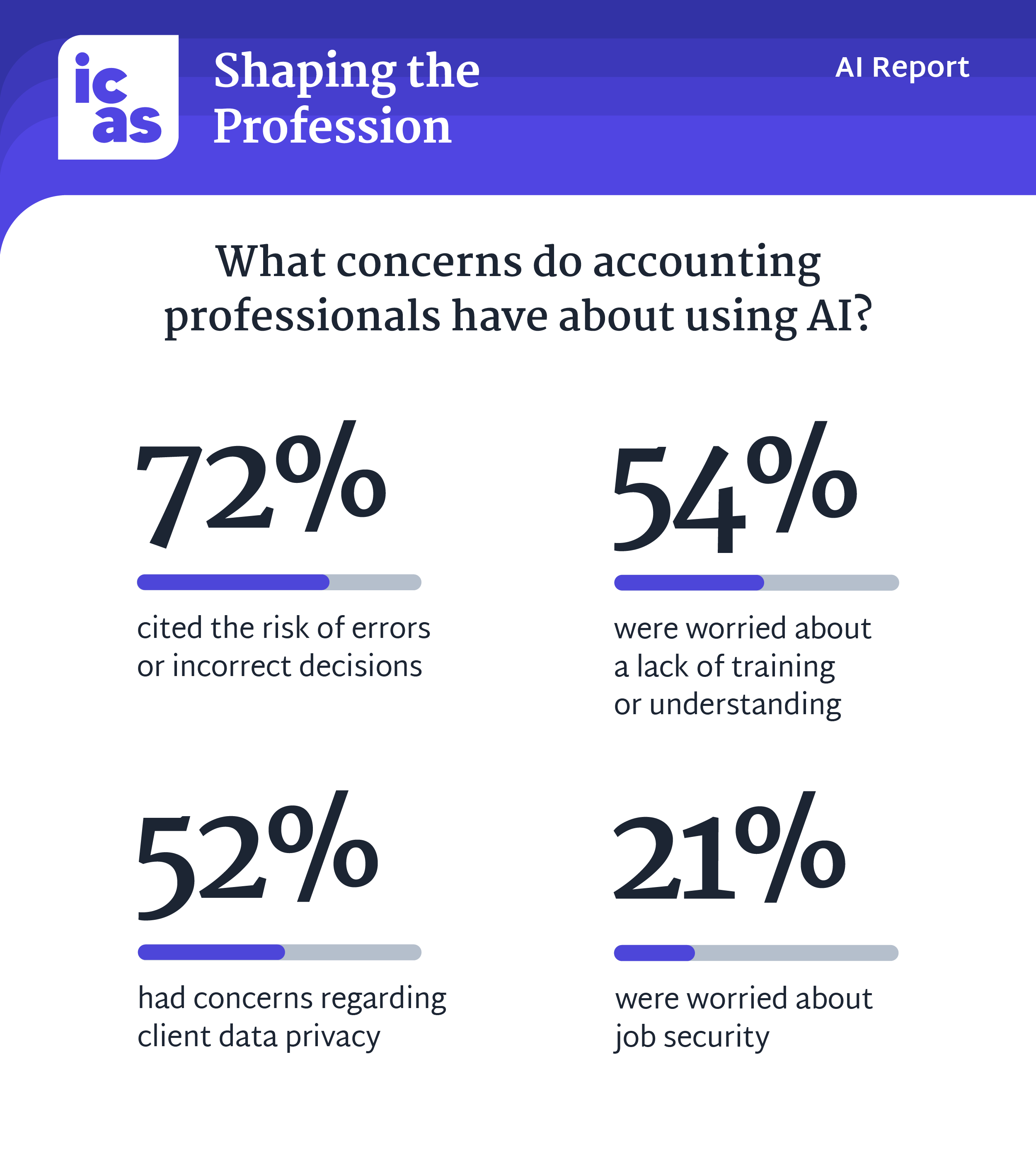
- Accountants are cautious about accuracy: More than two-thirds of respondents (72%) worry that Gen AI could produce errors or incorrect decisions, highlighting the need for careful review and strong oversight of outputs.
- Beware of the ethical and oversight risks: More than half of respondents (52%) raised worries about client data privacy and confidentiality. The research stresses that professionals must also stay alert to hidden cognitive biases that could skew their judgment.
- Routine tasks remain the most common use of Gen AI: More than half of respondents (53%) turn to Gen AI to write emails and edit text, while 46% use it to summarise meetings or documents. Around a third (33%) rely on it to support spreadsheet or other software-based tasks.
- Human judgement is essential: Gen AI performs best on routine, structured tasks but accounting work that demands nuanced understanding, collaboration or ethical decision-making continues to rely on professional human judgment. This helps explain why only a fifth of respondents (21%) said they were concerned Gen AI might affect their job security.
The report urges a clear, accountable approach to the responsible adoption of AI across the accounting profession and beyond. It calls on organisations to place ethics and human judgement at the heart of AI use, introduce safeguards to limit bias and over-reliance on AI outputs, and set clear frameworks for when and how the technology should be used.
The study also emphasises the need for strong oversight, clear accountability for decisions, and proactive steps to ensure AI does not widen skills gaps or restrict access to the profession.

Ewan McCall
ICAS Research and Thought Leadership lead, Ewan McCall, said the findings offer both an opportunity and a warning to the profession that while Gen AI may be accelerating routine work, it can’t replace the judgement and accountability than underpins public trust in accountants.
“The message from our research is clear: people, not machines, must remain firmly in the driving seat of professional decision-making.
“While Gen AI can help accountants work faster and handle many routine tasks more efficiently, the technology is only as effective as the information, supervision, and oversight behind it. Weak inputs lead to weak outputs, which over time erode the trust that underpins accounting work and wider society.
“Backed up by insight from research like this, the accountancy profession and every sector using Gen AI can rise to the challenge of making sure the technology is used critically and ethically to strengthen, not stifle, professional judgment.”

Share this article:

Subscribe to our newsletter to not miss articles like this one:
 SUBSCRIBE