
Written by:

John Healey promises ‘breathing space’ in first Budget as banks fund energy bill support
 Reading time: 9 minutes
Written by:
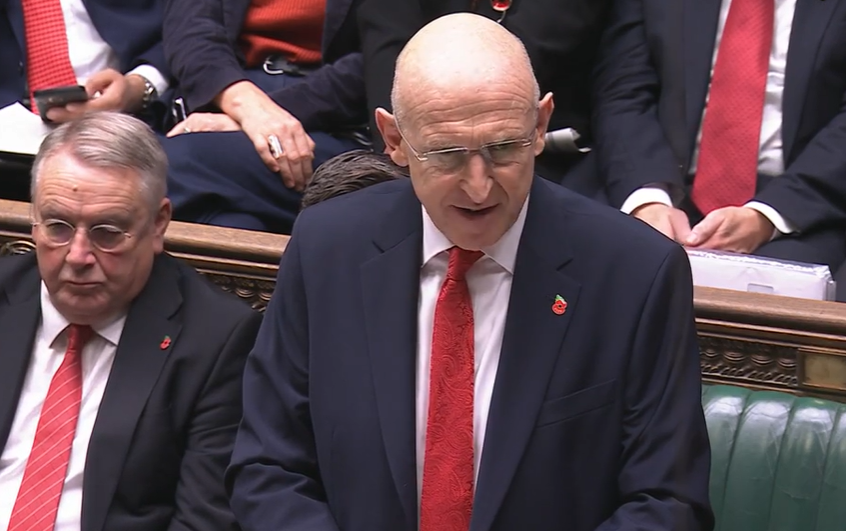
Chancellor John Healey
Chancellor John Healey has described his maiden Budget as one for “working people”, delivered through “fiscal discipline giving Britain breathing space on the cost of living”, as he looked to banks to temporarily fund the energy support measures.
Mr Healey confirmed that banks would pay a 6% surcharge on profits above £100m, starting in January and running for 15 months to help fund energy support. He said banks faced an additional 3% surcharge on top of the 3% they already pay.
Shares in UK banks rose after the announcement that taxes on the sector would rise by less than expected and for a limited period only. Lloyds Banking Group was up 4.2%, Barclays rose 3.7% and NatWest gained 2.4%.
Mr Healey said: “Our world-leading banks make a huge contribution to this country in the tax they pay, in the jobs, industry and investment they support. As Chancellor, I want to say directly to our banks: I celebrate and am grateful for the role you play.
“And amid global economic storms, I am looking to our banks to help fund breathing space for British families. And so banks will pay an extra 3% on the bank surcharge. This will be time-limited, to pay for immediate support on energy bills, starting in January, ending 15 months later.”
JPMorgan Chase hit out at the UK government’s decision to increase taxes on banks, stating: “To single out this industry for additional taxes again, one of the UK’s biggest generators of growth and jobs, lacks principle.”
The Chancellor confirmed that the government has economic headroom of around £15bn, telling the Commons: “The Office for Budget Responsibility (OBR) confirms today that headroom against the stability rule is £15bn in 2029/30, before rising to £22bn in 2030/31. That’s what a buffer is for. Use it when you need it. Rebuild it when you can.
“And so despite the global challenges, this Budget puts us on track to eliminate the current budget deficit and get Britain’s finances into the black within 3 years.”
He said the OBR forecast borrowing would fall to 4.2% of GDP this year, 3.4% next year, 2.1% in 2029/30 and 1.8% by 2030/31. The OBR predicted Britain would spend £14bn more on debt interest this year as the war in Iran continues, and Mr Healey blamed the conflict in the Middle East for the sluggish performance of the British economy.
Mr Healey said: “The OBR sets out that the war in the Middle East is a key driver affecting today’s forecasts, and this Government continues to work with our allies to end the conflict and restore shipping through the Strait of Hormuz.
“We did not want this war and we rejected the calls from the leader of the Opposition to jump two-footed into it. It’s a war that has driven up costs on British families and businesses. Inflation, which was due to fall earlier this year to the 2% target, has now risen, driven by higher oil and gas prices. Oil is up from around $70 a barrel to well over $100, and gas prices have nearly tripled since February.”
He said this meant higher petrol prices, energy bills and mortgages for the public, and higher running costs for businesses. He said debt as a share of GDP was forecast to fall to 81.7% in 2031/32, citing praise from the IMF that the UK “stands out” as a country where action to reduce debt and deficit has been taken decisively.
However, the OBR said welfare spending was expected to climb to £431.3bn by 2031/32, according to its latest forecasts.
During the Budget, Mr Healey also announced plans to cut £800m of red tape for businesses, saying investment was the biggest barrier for fast-growth firms. He pledged a further £20.4bn for the National Wealth Fund and the British Business Bank over the coming years, supporting 140,000 jobs.
He said: “I will work with pension providers, asset managers and the wider industry to accelerate more private investment into Britain’s innovative, fast-growth firms, removing regulation and tariffs worth £800m to business.
“We will legislate for a regulatory carve out so that innovative products like drones and medicines can be safely tested and rapidly scaled. And I am re-establishing the Better Regulation Executive to cut outdated regulations and admin burdens on businesses and workers.”
Mr Healey also announced a new form of capital gains tax relief for the founders of Britain’s biggest companies, saying: “I’m announcing founder’s relief, a brand new relief in capital gains tax. A 10% rate on lifetime gains of up to £10m for the founders of our most successful firms.”
The Chancellor also raised the trading allowance, the amount someone can earn tax-free from a new venture, from £1,000 to £3,000. He also announced the Enterprise Management Incentive 2 (EMI) which will offer employees share options worth up to £120,000, alongside existing EMI options. Mr Healey also announced plans to launch of a new Young Entrepreneurs Allowance, to cover a year of living costs for young founders and a new scale up programme to support female founders, and the British Business Bank will double its commitments to women-led businesses and funds to £200m.
He also used the Budget to address a £5bn gap in the defence investment plan, promising an “immediate” step to boost defence spending through the National Wealth Fund and British Business Bank, focused on “dual-use” technology and sovereign capabilities worth up to £5bn.
Mr Healey also confirmed a tax increase on gambling machines to help fund Britain’s struggling high streets, raising the duty from 20% to 25%. The increase will apply only to higher-stakes machines, with pubs and seaside arcades spared.
The state pension will rise to £13,036 from April, above the £12,570 tax-free allowance, which would have generated tax bills of over £90 for around a million retirees. The Chancellor confirmed that pensioners whose only income is the full new state pension will not pay income tax.
The yield on ten-year UK gilts fell from 5.35% to 5.32% shortly after the Chancellor spoke. The FTSE 100 rose 0.3%, lifted by gains in banking stocks following the announcement on temporary bank taxes.
Matthew Amis, investment director, at Aberdeen said:“The gilt market wanted dull and they got exactly that. With oil and gas prices this high and with one eye on France, a dull budget is what was needed.
“All of the major obstacles presented to Chancellor Healey were avoided, as such gilts yields are slightly out-performing. Is this a gilt positive budget? Not particularly, but in the context of this year that is good enough. 2027 is going to present another fiscal challenge for Chancellor Healey, but today’s budget should provide enough to reassure gilt investors going into the final months of 2026.”
The IPPR think tank, which is closely linked to the Labour government, was sceptical of the proposed founder’s relief. Helen Miller, director of the IFS, wrote on X: “Sounds to me like it might be bonkers… Am struggling to imagine an economic rationale.”
Paul Johnson, her predecessor at the IFS and now master of an Oxford college, replied: “Funnily enough I was thinking the same thing.”
Responding to Mr Healey’s first Budget, Conservative leader Kemi Badenoch told the Commons: “He talks about giving people breathing space but they are the ones choking the economy. £70bn of new taxes in just two years, and they’ve put them up again today.
“He said he wouldn’t be putting taxes on working people, that’s what the last chancellor said, but he has because they are taxing everything that they can get their hands on.
“They have taxed jobs, they’ve taxed pensions, taxed cars, they’ve taxed the rental market today, taxed savings, taxed investment, taxed homes. He asked me if I support [the measures] they are taking today. No, I do not support the action that they are taking today.”
Mr Healey also promised to “modernise” the tax treatment of investment by foreign sovereigns, which could tighten the beneficial treatment that makes direct overseas government investments immune from direct taxation. The exact details will be set out in documents released after his speech, but he said it would bring UK rules more in line with other countries while remaining “one of the most generous regimes in the world”.
Gail Boag, chief executive of ICAS, said short-term measures were “no substitute for a credible, detailed, long-term plan for growth”. She called on the Government to commit to “fundamental structural reform of the tax system”, adding that the forthcoming 10-year plan and spending review “must break the cycle of annual tax tinkering”.
He also U-turned on his predecessor Rachel Reeves’ plans to cut the cash ISA limit to encourage investment. Mr Healey confirmed a new Starter ISA for investment, but the personal savings allowance will remain frozen at 2016 levels. There was no announcement regarding a delay or cancellation of the planned IHT changes affecting pensions.
Alex Beavis, interim director of banking at LHV Bank, said: “A welcome dose of common sense. Cash ISAs give people a straightforward, tax-efficient way to save for a house deposit, build a buffer, or plan ahead with confidence. Encouraging more people to invest is a sensible ambition, but saving and investing aren’t interchangeable: cash is the safety net for life’s unexpected bills, while investments build wealth over the longer term.
“The new Starter ISA looks like a promising step for new investors, and we look forward to seeing the detail. Penalising people for wanting to save was always the wrong way to go about it. That said, it isn’t all good news for savers. The two percentage point rise in tax on savings held outside an ISA is going ahead, taking rates to 22%, 42% and 47%, and the Personal Savings Allowance hasn’t moved since 2016.
“A higher-rate taxpayer earning 4% only needs £12,500 in the bank before their interest becomes taxable, and from April a 4.5% rate will be worth just 2.61% to them on interest above their allowance. That makes the ISA shelter more valuable than ever, so anyone with money sitting in a standard savings account should make sure they’re using their allowance. We’d still urge the Chancellor to raise the Personal Savings Allowance so that saving isn’t penalised.”

Share this article:

Subscribe to our newsletter to not miss articles like this one:
 SUBSCRIBE