
Written by:

Scotland’s financial services sector ‘scarred’ by financial crash, says Douglas Alexander
 Reading time: 6 minutes
Written by:
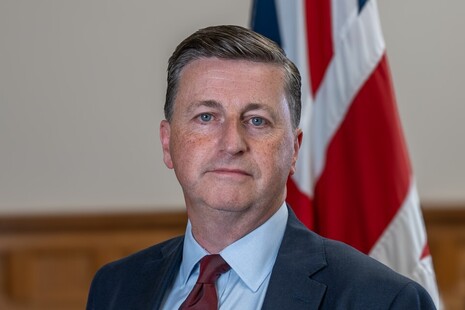
Douglas Alexander
The Secretary of State for Scotland Douglas Alexander has claimed Scotland’s financial services remains “scarred” by the financial crash, as he called for renewed confidence in the industry and greater collaboration between government and business to drive economic growth.
Mr Alexander told investors during a fireside chat at The Investment Association’s Scotland conference that Scotland had lost confidence in its financial services sector following the collapse and restructuring of major institutions during the financial crisis.
He pointed to the rise of RBS under Fred Goodwin, whose aggressive expansion culminated in the ill-fated £49bn takeover of ABN Amro shortly before the financial crash.
RBS subsequently required a £45.5bn taxpayer bailout, an episode Alexander said left Scotland’s financial services sector confidence in the industry damaged. The Secretary of State for Scotland argued that the country retained significant strengths in asset management and fintech.
He said: “I think the financial services sector in Scotland has been evolving over recent decades. I’m old enough that I remember the rise of RBS, whether it was James Walker, who did well, and others like Fred Goodwin coming into my office in the Department of Business at the time, in their pomp and in their certainty that this was a viable model going forward, at the time an independent Bank of Scotland as well as RBS and the rest.
“My sense is after that a lot of confidence was lost, even in Scotland, and I see that as someone with a big interest in the Scottish financial services sector and fintech as well. We’ve still got the expertise in terms of asset management. We’ve still got the rapidly growing expertise in terms of fintech and some of the innovation.”
Mr Alexander opened up on his nine years outside politics, revealing that “every aspect” of his “life got better” when he lost his seat in 2015, a year after the Scottish Independence Referendum, that saw him founding his own consultancy business.
He returned to government in 2024 following years working across business, consultancy, professional services and investment. He worked with US private equity firm TPG in San Francisco and regularly sat on its investment committee, an experience he said had given him a greater understanding of capital allocation and how investors identify trends and opportunities.
He rejected the suggestion that politicians were inherently less capable of understanding business than people working in the private sector.
“Talent is pretty evenly distributed,” Mr Alexander said. “You have really talented people in politics, corporate law and investment, and you have some complete schmucks and idiots in all of them as well.”
But he accepted it was reasonable to question whether policymakers understood the incentives and challenges facing different sectors of the economy. He said: “If we are serious about raising the trend rate of growth both in the UK economy and the Scottish economy, we need the wealth creators around the table.
Scotland needs to rebuild entrepreneurial ambition
Mr Alexander said Scotland also needed to develop a stronger culture around entrepreneurship and wealth creation. He added: “If you look at Scotland at the turn of the millennium, say 25 years ago, we had still at that time the general insurance, the Standard Lifes, the Scottish and Newcastle, big corporate Scottish-based entities.
“A number of those are no longer with us. It feels to me that we need to generate that same sense of excitement again, and conferences like today are more timely and important than ever.”
He argued that Scotland should do more to recognise the contribution of entrepreneurs and businesses to the wider economy. “We have a responsibility collectively to find ways to celebrate the dignity and worth of people who run their own business.
“Government’s responsibility is very often to create context of stability, create an investable environment, and to facilitate and empower the private sector to lead,” he said.
Scaling remains a problem
The Government minister acknowledged that Scotland and the wider UK continued to struggle to help promising companies scale. He said that during his time working in investment, where he dealt with companies at the growth stage and transactions involving £15m or more, he repeatedly encountered the difficulty of getting businesses to the next level.
“We have a real challenge getting businesses to that scale,” he said. “People invest in companies, they don’t invest in countries.”
He highlighted university spin-outs, growth capital and capital-market reforms as areas where more could be done to keep ambitious businesses in Scotland and the UK.
He said some companies he encountered during his commercial career received higher valuations in the US and consequently viewed America as the logical next step, adding: ‘We need the wealth creators around the table”.
Mr Alexander said greater involvement from entrepreneurs and investors would be important if Scotland was to raise its long-term growth rate.
“If we are serious about raising the trend rate of growth both in the UK economy and the Scottish economy, we need the wealth creators around the table,” he said. He added that they needed to be more than simply consulted by government.
“They can’t be only voices at the table, but they absolutely need to be at the table.”
Defence and energy offer opportunities
The minister identified defence and energy as two sectors with significant growth potential in Scotland, pointing out to the ‘increased’ defence spending, arguing that Scotland needed to capture not only major contracts but the wider supply-chain benefits.
He said: “It’s good news for Scotland, but we need to make sure that we are securing everything that’s involved in terms of the industry supply chain. Whether it’s energy, whether it’s defence, or whether it’s just the foundational economy, the fiscal rules and stability, it feels to me that this is a platform for progress.”
Devolution and regional growth
He also called for greater cooperation between the UK and Scottish governments on regional economic development.
He pointed to the experience of Greater Manchester and Andy Burnham’s approach to regional growth, arguing that Scotland could learn from the importance of city regions and place-based economic policy.
He said Scotland faced many of the same challenges that England’s regional devolution agenda was designed to address, including low growth, regional imbalance and centralisation.
He said: “The paradox is we have the most powerful devolved legislature anywhere in the United Kingdom, but we’re still one of the most centralised nations in Europe.”
He argued that greater local involvement could also improve employment outcomes by allowing policymakers to work more closely with employers, adding: “If you’re trying to get young unemployed people into work, talking to local employers actually accelerates the timetable and the process, but also better understands actually the needs of the businesses.”

Share this article:

Subscribe to our newsletter to not miss articles like this one:
 SUBSCRIBE