Chancellor John Healey is set to increase taxes on Britain’s banks to help plug a hole in the UK Government’s finances caused by rising borrowing costs. Mr Healey is considering options for raising more revenue from Britain’s financial institutions ahead of the Budget on 28 October

John Healey
The UK Government has announced Edinburgh will host the G20's annual finance meeting next summer. Central bank governors and finance meetings will meet at the Edinburgh International Conference Centre on July 8 and July 9, as part of a series of events around the G20 Leaders' Summit in Manchester in
The International Monetary Fund (IMF) has praised the UK Government for taking "decisive measures to cut future spending and raise taxes as it urged ministers to "stay the course" ahead of its upcoming Budget. Kristaline Georgieva, the institution's managing director, claimed Britain's budget defici
Economists have warned that Chancellor John Healey's fiscal headroom could be wiped out by the impact of the Iran War. They claimed that the forecast by the Office for Budget Responsibility (OBR) could offer a ore pessimistic view on the UK economy as analysts from EY suggest the buffer against a bo
John Swinney is facing a 'demanding test' at the Scottish Budget on December 3 on whether the Scottish Government's five-year ambitions can be met within a resource budget forecast to fall 1.2% in real terms in 2027-28, a figure that could change after the UK Budget, the Fraser of Allander Institute
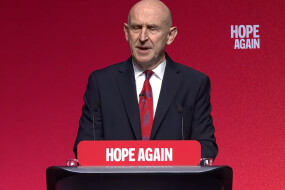
Chancellor John Healey has promised to restore hope to the UK through "fiscal discipline," supporting "good work" and "strong industries," in a major speech ahead of the Budget. Mr Healey used his speech at the Labour Party Conference to focus on fiscal policy, stating that it was "not progressive"
Nigel Green has claimed that the UK could be “Truss’d” in a stark warning as gilt yields surge, drawing comparisons with the market turmoil that followed Liz Truss’s mini-budget in 2022. The chief executive of deVere Group, one of the world’s largest independent financi
Chancellor John Healey faces a £3.5bn borrowing overshoot in August ahead of his inaugural Budget. The government was expected to borrow around £14.8bn in August, according to the OBR, while the market consensus was around £15.6bn. Actual borrowing reached £18.3bn.
The UK economy grew by 0.4% in July, faster than analysts’ expectations, and offering some relief to battered markets. Some economists had predicted no growth and the latest figure builds on growth of 0.3% in June and zero growth in May.
The Association of Investment Companies (AIC) has called on Chancellor John Healey to remove stamp duty by the end of this parliamentary term to unlock growth. Investors must pay 0.5% stamp duty tax to the UK Government when buying UK shares or other chargeable securities, which the AIC warns is mak
Chancellor John Healey has claimed growth is at the "heart of fiscal challenges" facing the UK, as he refused to rule out tax rises ahead of his maiden Budget next month. The Chancellor ignored questions about whether households and businesses were set to face another set of tax rises in October, fo
Chancellor John Healey is facing "sleepless nights" over a growing "inflation monster" due to surging oil prices, rising interest rate expectations and spikes in government gilt yields threatening markets on both sides of the Atlantic ahead of his inaugural Budget. High borrowing costs are expected
A Budget tax raid on British banks would hand a competitive gift straight to rival global financial centres, according to the chief executive of one of the world’s largest independent financial advisory organisations. Nigel Green of deVere Group urged Chancellor John Healey to dismiss union le
Investors and analysts have warned Chancellor John Healey not to give up on the government's efforts to reduce the UK's fiscal deficit in his first Budget, following a spike in government bond yields in recent weeks. Mr Healey is preparing to unveil his first Budget on October 28 at a time when inve
Former NatWest chairman and financial regulator Sir Howard Davies has launched a scathing attack on the UK's banking framework, claiming that post financial crisis ring-fencing was a "completely useless regulatory intervention" that has "emasculated UK investment banking." Speaking as ministers weig